
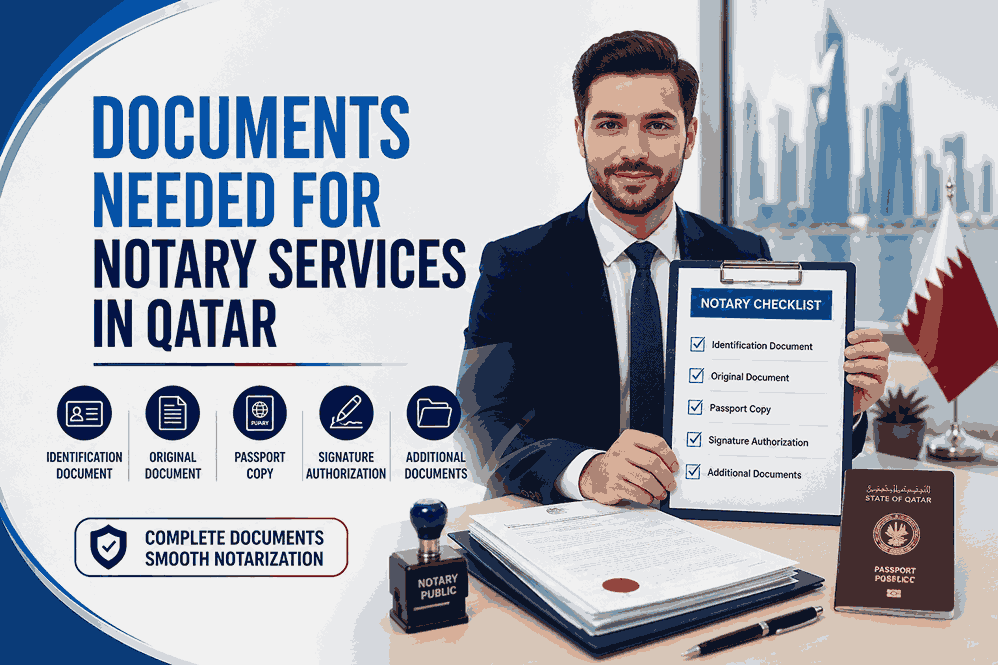
Getting a document notarised sounds simple, but a lot of people get stuck at the first step — not knowing what papers to bring or what format is accepted. If you walk in without the right documents, you might have to come back again, and that just wastes your time.
So here’s a simple breakdown of what you actually need, how the process works, and a few things people often miss.
What Documents Do You Need?
The exact list depends on what you’re getting notarized, but most cases need these basics:
- The original document you want notarized (a photocopy alone usually won’t work)
- Your passport or Qatar ID — original plus a photocopy
- Proof of authority, if you’re signing on behalf of a company
- A translated version, if your document isn’t in Arabic
- Any extra papers the notary office asks for, depending on the case
For example, if you’re notarizing a Power of Attorney, you’ll usually need your ID, the drafted POA document, and details of the person you’re authorizing. If it’s a true copy attestation for a bank loan, you’ll need the original along with a clear photocopy.
Step-by-Step Process
Here’s roughly how it goes, from start to finish:
1. Share your document — Tell us what you need done, and send across whatever paperwork you already have. You don’t need everything figured out beforehand.
2. Document review — We go through it first to check if anything’s missing, wrongly worded, or likely to cause a rejection later.
3. Translation (if needed) — If your document isn’t in Arabic, it usually needs to be translated before notarization.
4. Notarization — Your document gets signed, verified, and stamped by an authorized notary, making it legally valid.
5. Attestation (if required) — Some documents need an extra attestation step, especially if they’re headed abroad or being submitted to an embassy.
6. Final delivery — Once everything’s done, you get your notarized (and attested, if needed) document back, ready to use.
Do You Need Translation First?
This depends on the language of your original document. If it’s not in Arabic, and it’s going to a Qatari authority, it usually needs a proper Arabic translation before notarization can happen. Skipping this step is one of the most common reasons documents get rejected or delayed. If you’re not sure whether your paper needs translating, it’s better to check first — our translation services in Qatar team can confirm this for you before you submit anything.
When Do You Need Attestation Too?
Notarization and attestation are two different things. Notarization confirms your signature or document is genuine. Attestation is an extra layer that makes your document valid for use in another country — like if you’re sending a Power of Attorney to India, or submitting a document to a foreign embassy.
Not every document needs this, but a lot of NRI and expat paperwork does. If you’re unsure, it’s worth checking with our certificate attestation services in Qatar team so you don’t miss a required step.
Notary Support for Companies
If you’re notarizing documents on behalf of a business — like board resolutions, shareholder agreements, or authorization letters — you’ll usually need:
- Proof that you’re authorized to sign for the company (like a trade license or board decision)
- The company document itself, properly drafted
- ID of the signing person or representative
Company documents tend to have stricter formatting rules, so it’s worth getting these checked before your notary appointment, not after.
Notary Support for Individuals
For personal documents — affidavits, declarations, POA, true copies — the process is usually simpler. You mostly just need your ID, the original document, and sometimes a translation. Most personal cases can be completed the same day.
FAQs About Notary Documents
Do I need the original document, or is a copy enough? You need the original. A copy alone can’t be notarized on its own — but we can create a certified true copy from your original if that’s what you need.
What if my document is in English — do I still need translation? It depends on where it’s being submitted. Some Qatari authorities accept English, others require Arabic. It’s best to check case by case.
Can I get everything done in one day? Most personal documents can be handled same-day. Company documents or ones needing translation and attestation might take a little longer.
What if I’m not sure what documents I need? That’s completely normal — just share what you have, and we’ll tell you what’s missing before you make a trip for nothing.
Ready to Get Started?
Once you know what’s needed, the rest of the process is quick and straightforward. Whether it’s a personal affidavit or a company document, our notary public services team in Qatar can walk you through it and get it done the same day, without the back-and-forth.