
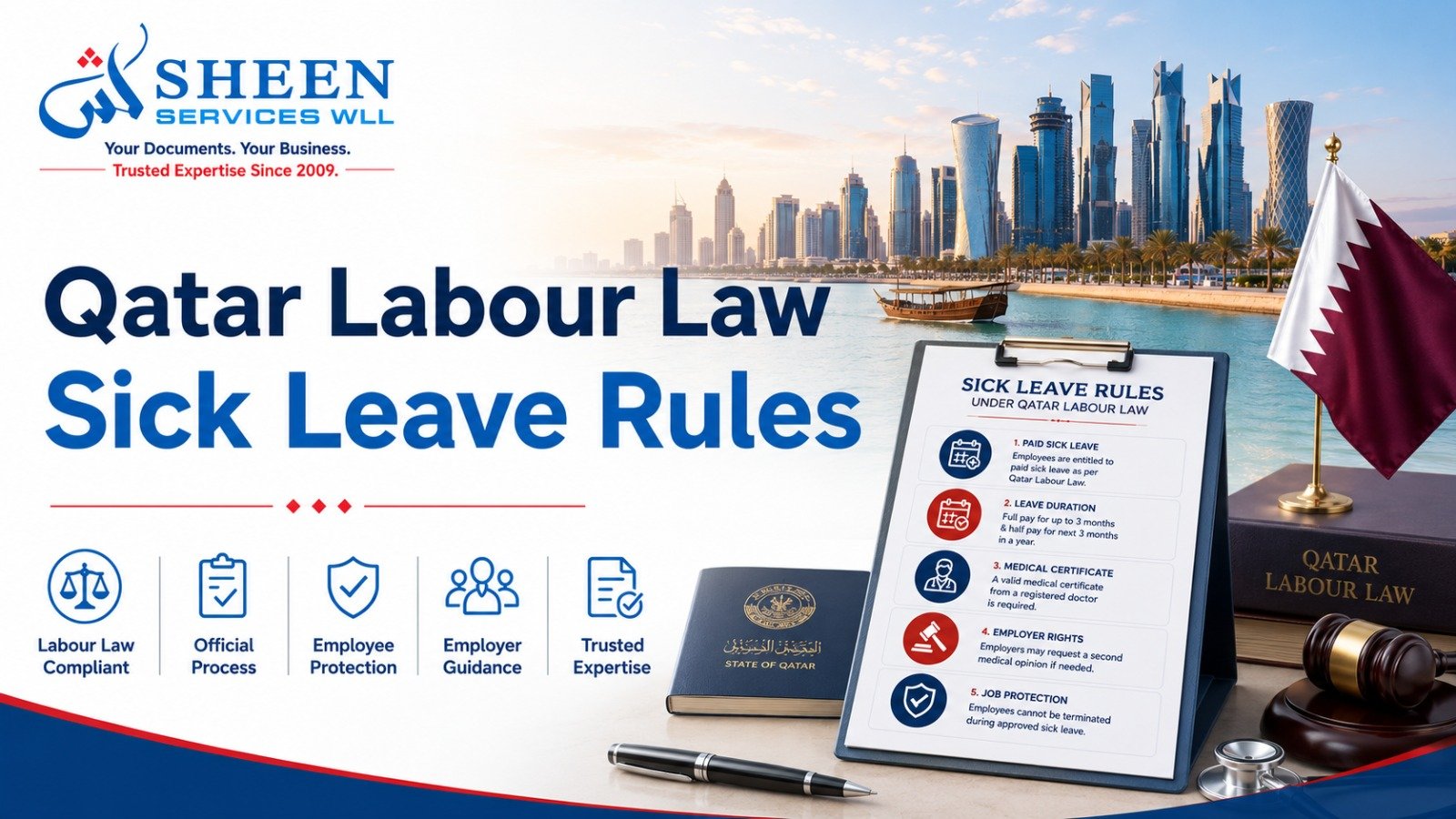
What Qatar labour law says about sick leave (Article 82 overview) Article 82 of Qatar’s
Labour Law No. 14 of 2004 gives every worker the right to paid sick leave for each year of service. This right isn’t automatic from day one — it activates only after the employee completes three months of continuous employment with the same employer, and it requires a medical certificate from a physician recognised by the employer. If an employee falls ill, they (or someone on their behalf) must notify the employer as soon as reasonably possible.
How many sick days are you entitled to in Qatar?
This is the part most guides skip—here’s the exact breakdown once you’ve completed three months of service and hold a valid medical certificate:
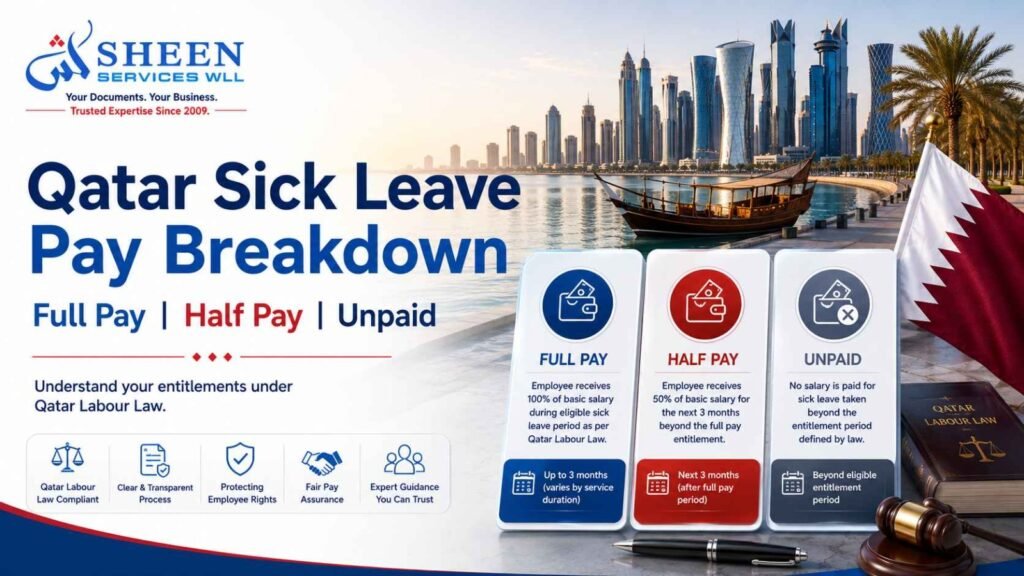
- First 2 weeks: full wage
- Next 4 weeks: half wage
- Beyond 6 weeks (up to week 12): unpaid, but the job is protected
- After 12 weeks: if a competent physician’s report confirms the employee still cannot return to work, the employer may lawfully terminate the contract on medical grounds
Importantly, taking up to twelve weeks of sick leave in total does not break your continuous service record — this matters for end-of-service benefit calculations, annual leave accrual, and length-of-service entitlements. If an employee dies from illness before using up their six weeks of paid entitlement, the employer must pay the remaining balance to the worker’s family. If an employee resigns for health reasons with a physician’s approval before their paid sick leave is exhausted, they’re still entitled to receive the remaining balance.
Who is eligible — and who is excluded? Any employee under a valid private-sector employment contract in Qatar who has completed three months of service can claim sick leave under Article 82. This applies to full-time and part-time private-sector workers alike.
However, Qatar’s labour law does not cover the following:
- Domestic workers (governed by a separate domestic workers law)
- Employees on personal sponsorship arrangements outside standard employment contracts
- Public sector and government employees, who fall under a separate civil human resources framework with potentially different entitlements
If you fall into one of these categories, check your specific contract or the relevant sector regulation rather than assuming Article 82 applies directly.
Medical certificate requirements for sick leave
- Official certificate: A medical certificate from a recognised Qatari health provider (hospital, clinic, or authorised doctor) is required to support any sick leave claim.
- Private and public clinics: Certificates from both public hospitals and licensed private clinics are generally accepted; some employers specify approved providers in advance.
- Content of the certificate: It should state the diagnosis (or simply “unfit for work”), the recommended leave period, and the doctor’s signature and clinic stamp.
- Translation and attestation: If the certificate is issued in a language other than Arabic or English — for example, from a doctor abroad — a certified translation and, in many cases, attestation will be needed before HR or the Ministry will accept it. See the certified translation services section below for how this works in practice.
Salary and pay rules during sick leave Pay during sick leave in Qatar follows the fixed statutory formula under Article 82, not employer discretion—though employers can offer more generous terms if they choose.
- Full wage for the first two weeks of certified sick leave
- Half wage for the following four weeks
- No pay beyond six weeks, though the position remains protected up to week 12
- Wages are calculated on the employee’s basic wage as it stands on the date the leave falls (relevant if a leave period spans a pay rise or year-end)
Some companies build additional paid sick days into their HR policy on top of the statutory minimum — always check your contract and employee handbook, since employers cannot pay less than Article 82 requires, but can pay more.
What happens if sick leave goes beyond 12 weeks?
If an employee is still medically unfit to work after 12 weeks of sick leave, the employer has the legal right to terminate the contract — but only on the basis of a report from a competent physician confirming the employee cannot resume work at that point. This isn’t automatic or discretionary; it requires documented medical evidence. Even in this scenario, the employee’s end-of-service benefits remain unaffected by a termination on medical grounds.
What employees should do before taking sick leave
- Notify your employer promptly — inform your manager or HR as soon as you’re unfit for work, through your company’s required channel.
- Get a proper medical certificate — visit an approved medical provider and obtain a certificate specifying the recommended leave dates.
- Submit documents promptly — provide the certificate and any required forms to HR or your supervisor per company procedure.
- Keep records — retain copies of certificates, prescriptions, and any correspondence for future reference or disputes.
What employers may require for sick leave approval
- Verification: Employers may request certificates from designated clinics or a second medical opinion for extended absences.
- Fitness to return: A medical fitness certificate may be required before an employee resumes duties.
- Internal forms: Many organisations use HR forms or online portals to log and track sick leave submissions.
Documents required for sick leave in Qatar
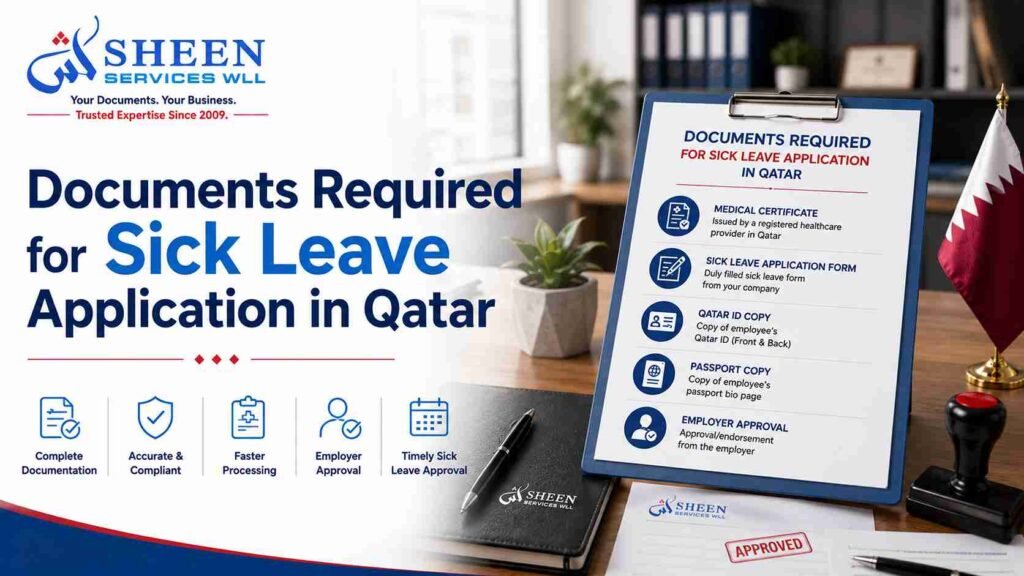
- Medical certificate from an authorised health provider
- Employee’s Qatar ID (QID) or passport copy for verification
- Completed HR or company sick leave form (if used)
- Follow-up medical reports for extended absences
- Translated or attested documents if the certificate was issued abroad or in a different language
A medical certificate should include the doctor’s details, dates of unfitness, signature, and clinic stamp.
Keep the original where possible, in case HR or MOL requests it later.
Qatar ID or employee details. HR will usually require your QID number, company ID, and contact information to process leave and adjust payroll accordingly.
Employer request or HR form Complete any internal paperwork your company requires for record-keeping and payroll adjustments – notary services Qatar Labour Law on Sick Leave: Rules, Salary and Documents
Certified translation and attestation, if required If your documents aren’t in Arabic or English, use certified translation services to avoid processing delays, and arrange document attestation where the employer or ministry requires it. This is the single most common reason foreign-issued sick leave claims get delayed — sort translation and attestation as early as possible rather than after HR flags the certificate as unreadable.
Need this sorted quickly? Have a medical certificate issued outside Qatar? Sheen Services can translate and attest to it for HR submission — contact Sheen Services for assistance with medical document translation and attestation.
Common problems employees face with sick leave
- Insufficient documentation: Missing or vague certificates can lead to leave rejection.
- Late notification: Failing to notify HR promptly can cause payroll or disciplinary issues.
- Disagreement over pay: Article 82’s formula is fixed by law, but confusion often arises when employers apply it incorrectly — refer to your contract and the breakdown above if there’s a dispute.
- Foreign medical certificates: These often need attestation and translation before employers or the Ministry will accept them.
How Sheen Services can help with sick leave documentation: Sheen Services supports employees and employers with
- Certified translation services for medical certificates and foreign documents
- Document attestation to meet employer or Ministry standards
- Notary services for signatures and HR forms
- PRO support to liaise with authorities and manage paperwork
We can review your documents, translate and attest as needed, and help you submit complete records to HR or the relevant authorities.
Practical step-by-step for employees taking sick leave
- Inform your manager or HR immediately through the required channel.
- Visit a recognised health provider and obtain a detailed medical certificate.
- Submit the certificate and any HR forms to your employer promptly.
- If the certificate is from abroad or in another language, arrange certified translation and attestation.
- For extended leave, provide periodic medical updates as requested.
- Before returning, obtain a fitness-to-work certificate if your employer requires one.
Conclusion
Qatar’s labour law on sick leave gives every eligible private-sector employee a clear, fixed entitlement under Article 82: two weeks at full pay, four weeks at half pay, and job protection up to twelve weeks — provided you have three months of service and a valid medical certificate. Notify your employer promptly, keep your documentation in order, and if you’re dealing with a foreign-issued certificate, get translation and attestation sorted early to avoid payroll delays. Sheen Services offers translation, attestation, notary, and PRO support to help you manage sick leave documentation smoothly.
FAQ Section
Q1: What is the sick leave rule in Qatar?
A1: Under Article 82 of Qatar Labour Law No. 14 of 2004, employees with at least three months of service get two weeks of sick leave at full pay, four weeks at half pay, then unpaid leave with job protection up to twelve weeks, provided they submit a valid medical certificate.
Q2: How many sick days am I entitled to in Qatar per year?
A2: Up to twelve weeks per year of service: two weeks at full pay, four weeks at half pay, and six weeks unpaid but job-protected.
Q3: Is a medical certificate required for sick leave in Qatar? A3: Yes. A medical certificate from a recognised Qatari health provider is required to approve sick leave and process payroll correctly.
Q4: Is sick leave paid in Qatar?
A4: Yes, for the first six weeks: two weeks at full wage and four weeks at half wage. Beyond that, leave is unpaid but the position is protected up to week twelve.
Q5: What happens after 12 weeks of sick leave in Qatar?
A5: If a competent physician confirms the employee still can’t return to work after twelve weeks, the employer may legally terminate the contract on medical grounds. End-of-service benefits are unaffected by this type of termination.
Q6: Does Qatar labour law cover domestic workers’ sick leave?
A6: No. Domestic workers, personal-sponsorship employees, and public sector staff are excluded from Article 82 and are governed by separate rules.
Q7: Can an employer request a second medical opinion?
A7: Yes. Employers may request verification or a second opinion, especially for prolonged absences or where company policy allows it.
Q8: Do foreign medical certificates need translation or attestation?
A8: Often yes. Certificates issued outside Qatar or in a language other than Arabic or English typically require certified translation and attestation before employers or authorities will accept them.
Q9: How soon should I notify my employer if I fall sick?
A9: As soon as possible — ideally on the first day of illness or according to your company’s notification policy.
Q10: Can Sheen Services help with sick leave paperwork?
A10: Yes. Sheen Services offers translation, attestation, notary, and PRO services to prepare and submit required documents on your behalf.