
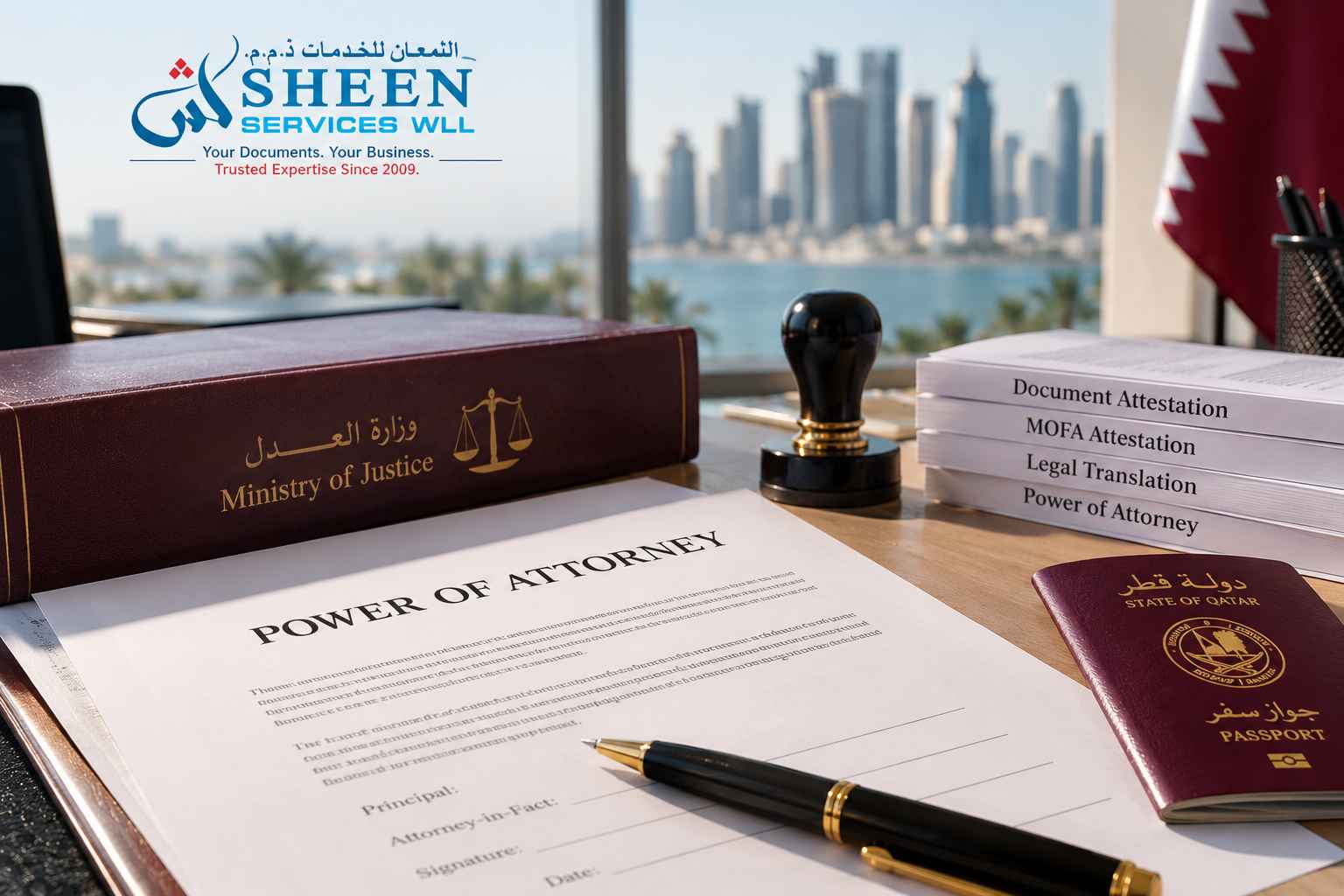
Power of Attorney attestation in Qatar depends on where the document was issued, what authority it gives to another person and where it will be used.
A Power of Attorney (POA) prepared in Qatar may require documentation through the Ministry of Justice. A POA issued abroad may need authentication by the relevant authorities before it can be submitted in Qatar. Ministry of Foreign Affairs (MOFA) attestation may also be required, particularly when documents cross international borders.
However, notarisation and MOFA attestation are different procedures. Not every Power of Attorney requires the same combination of steps.
This guide explains the relevant authorities, documents and procedures so you can identify the requirements for your situation.
Does a Power of Attorney Need Attestation in Qatar?
A Power of Attorney may need official documentation or attestation in Qatar, depending on its intended use and the requirements of the organisation receiving it.
For example, someone might issue a POA to authorise another person to manage a business transaction, represent them in a legal matter or complete a specific administrative task.
Before preparing the document, it is important to establish whether the receiving authority requires a notarised POA, additional authentication or MOFA attestation.
Three Situations to Distinguish
| Situation | What to check |
|---|---|
| POA issued in Qatar for use in Qatar | Whether Ministry of Justice documentation is required and whether the receiving authority has additional conditions |
| POA issued abroad for use in Qatar | Whether foreign authentication, embassy legalisation, MOFA attestation or another official procedure is required |
| POA issued in Qatar for use abroad | Whether the destination country requires Qatar MOFA attestation and further consular legalisation |
These situations should not be treated as one universal attestation process.
The correct procedure depends on the issuing authority, the document’s purpose and the requirements of the organisation that will accept it.
Power of Attorney Notarisation vs MOFA Attestation
Notarisation and MOFA attestation serve different purposes. Notarisation concerns the formal documentation or authentication of a legal instrument, while MOFA attestation concerns the official authentication or legalisation of documents.
In Qatar, the Ministry of Justice provides documentation services for different categories of Powers of Attorney. The Ministry of Foreign Affairs provides attestation services for documents requiring the relevant official authentication.
| Feature | POA notarisation or documentation | MOFA attestation |
|---|---|---|
| Main authority | Ministry of Justice | Ministry of Foreign Affairs |
| Primary purpose | Formal documentation of the Power of Attorney | Authentication or legalisation of the document |
| Common use | Establishing or recording authority granted to another person | Meeting applicable document-authentication requirements |
| Applies to every POA? | Depends on the document and intended transaction | No |
| Can both be required? | Yes, depending on the circumstances | Yes, depending on the circumstances |
For a broader explanation, read Sheen Services’ guide to MOFA attestation versus notary services in Qatar.
The important point is that obtaining one form of authentication does not automatically establish that every other requirement has been satisfied.
Which Authority Handles Power of Attorney Attestation in Qatar?
The two principal authorities discussed in POA documentation and attestation are the Ministry of Justice and the Ministry of Foreign Affairs.
Their responsibilities differ, so identifying the correct authority is an essential first step.
Ministry of Justice (MOJ)
Qatar’s Ministry of Justice provides documentation services for different types of Powers of Attorney.
These include general Powers of Attorney, special Powers of Attorney and certain purpose-specific authorisations.
For example, the official Attestation of General Power of Attorney service describes documentation of an instrument granting an agent broad authority to represent the principal.
The Ministry also provides separate services for particular legal and commercial purposes.
Choosing the appropriate category matters because the supporting documents and conditions may differ.
Ministry of Foreign Affairs (MOFA)
Qatar’s Ministry of Foreign Affairs provides document-attestation services through its Consular Affairs functions.
Its published services include general and special Powers of Attorney, as well as commercial Powers of Attorney.
For commercial documents, the official MOFA Commercial Power of Attorney service explains the authentication requirements and available application channels.
MOFA’s published conditions also address the official seals and signatures required for relevant documents.
The applicable procedure must be checked against the specific document and its authentication history.
Documents Required for Power of Attorney Attestation in Qatar
The documents required depend on the type of POA, the applicant and the relevant government service.
There is no single checklist that applies to every Power of Attorney.
According to the Ministry of Justice’s published General Power of Attorney service information, the documents that may be relevant include:
- Valid Qatar ID or passport.
- The Power of Attorney document or relevant draft.
- Commercial Registration for an applicant that is a commercial company.
- Establishment registration card for applicable legal entities.
- Commercial licence for relevant professional activities.
- Evidence of authority where someone signs on another person’s behalf.
- Arabic translation when the document is in another language.
- Additional supporting documents or approvals where applicable.
Not every item is required for every applicant.
Additional Checks for Company-Related Powers of Attorney
A company-issued POA may require additional information establishing who has authority to act for the business.
Before submitting a company-related POA, check whether the receiving authority needs:
- Current company registration documents.
- Identification of the authorised signatory.
- Evidence that the signatory may grant the proposed authority.
- A clearly defined description of the representative’s powers.
- Additional documentation specific to the intended transaction.
These are preparation checks rather than a universal list of mandatory government documents.
For general documentation requirements, see Sheen Services’ guide to notarising documents in Qatar.
How to Attest a Power of Attorney Issued in Qatar
For a POA prepared in Qatar, the first task is to determine the correct Ministry of Justice documentation service.
Whether further MOFA attestation is required depends on the document’s intended use and the receiving authority’s requirements.
Step 1: Identify the Authority Being Granted
Start by defining exactly what the appointed person needs permission to do.
For example, the POA may concern:
- A specific business transaction.
- Representation before a particular organisation.
- Banking-related actions.
- Property-related matters.
- A defined legal or administrative task.
Avoid using broad wording when the receiving authority requires a specific authorisation.
A document that does not clearly cover the intended action may need amendment before it can be used.
Step 2: Select the Appropriate MOJ Service
The Ministry of Justice distinguishes between general and special Powers of Attorney.
A general POA grants broader authority, while a special POA concerns defined actions or purposes.
Some transactions have dedicated documentation categories.
Check the relevant official service description before preparing the application.
Step 3: Prepare the Required Documents
Gather the identification and supporting documents listed for the selected service.
Check that names, identification details and the scope of authority are consistent.
Where a company is involved, confirm that the person signing has the necessary authority.
Step 4: Complete the Applicable Documentation Procedure
Follow the Ministry of Justice’s current instructions for the selected POA category.
Some MOJ services are described on Qatar’s Sharek portal as “Incomplete Digital”.
This means applicants should not assume that every stage can be completed entirely online.
Confirm the available submission method and whether additional verification or attendance is necessary.
Step 5: Check Whether Further Attestation Is Required
Once the POA has been documented, confirm whether the receiving organisation requires additional authentication.
For a POA intended for use abroad, this may involve Qatar MOFA attestation and further requirements imposed by the destination country.
Do not assume that a notarised document will automatically be accepted by every foreign authority.
How to Attest a Foreign-Issued Power of Attorney for Use in Qatar
A Power of Attorney issued outside Qatar may require authentication through the relevant authorities before it can be used for an official transaction in Qatar.
The exact requirements depend on the issuing country, the type of document and the organisation receiving it.
Step 1: Confirm the Receiving Authority’s Requirements
Before beginning the attestation process, identify the organisation in Qatar that will receive the POA.
Ask whether it requires:
- A particular form of Power of Attorney.
- Authentication in the country of issue.
- Embassy or consular legalisation.
- Qatar MOFA attestation.
- Arabic translation.
- Additional Ministry of Justice documentation.
This is particularly important for legal, banking, property and company-related transactions.
Step 2: Check the Authentication Completed Abroad
A foreign-issued POA may need to be authenticated by the competent authorities in the country where it was prepared.
The appropriate sequence depends on that country’s procedures and the requirements applicable to documents intended for Qatar.
A notarised document should not automatically be assumed to have completed the necessary international authentication process.
Step 3: Confirm Embassy and MOFA Requirements
Qatar MOFA’s published attestation conditions refer to the required official seals and signatures, including those of relevant diplomatic missions.
Before submission, check that the document has the authentication required for its particular route.
If the document is missing a necessary authentication, the applicant may need to resolve that issue before proceeding.
Step 4: Check Whether MOJ Acceptance or Deposit Applies
Qatar’s Ministry of Justice also publishes a service titled Acceptance and Deposit of a Document Authenticated Before a Foreign Authority.
This service concerns accepting and recording documents authenticated by competent foreign authorities.
It does not mean that every foreign-issued POA must undergo that particular procedure.
The applicable requirements should be confirmed for the intended transaction.
Step 5: Prepare the Document for Its Intended Use
Once the relevant authentication requirements have been satisfied, confirm that the receiving authority will accept the document in its present form.
Check whether it needs the original, an accepted copy, an Arabic translation or additional supporting documents.
Example: Authorising a Representative in Doha
Suppose a person living outside Qatar wants to authorise a representative to complete a company-related transaction in Doha.
Before arranging attestation, the person should confirm the exact powers required by the receiving organisation, the authentication needed in the issuing country and whether further Qatar-based procedures apply.
This is an illustrative scenario, not a prescribed procedure for every country.
When Is Arabic Translation Required for a Power of Attorney?
Arabic translation may be required when a Power of Attorney is prepared in another language and submitted for a Ministry of Justice documentation service.
The Ministry’s published General Power of Attorney requirements include Arabic translation where the document is written in another language.
However, translation requirements can differ between authorities and document categories.
Before arranging translation, confirm:
- Which language the receiving authority accepts.
- Whether a certified translation is required.
- Whether the original document must accompany the translation.
- Whether names and identification details must follow a particular format.
- Whether the translation itself requires additional authentication.
Translation and attestation are separate procedures.
Translating a document does not automatically make it notarised or legally authenticated.
For assistance with language requirements, see Sheen Services’ translation services in Qatar.
Common Reasons a Power of Attorney May Need Correction
POA documentation and attestation can become more complicated when the document does not match the intended transaction or lacks the required supporting information.
The following are practical issues to check before submission.
Unclear Authority Granted to the Representative
A POA should identify the actions the appointed person is authorised to perform.
If the wording does not cover the intended transaction, the receiving organisation may request clarification or a revised document.
Missing Authentication
A foreign-issued POA may require a particular chain of official authentication.
Check the relevant seals and signatures before arranging the next stage.
Inconsistent Identification Details
Names, identification numbers and company information should be checked across the POA and its supporting documents.
Discrepancies may require clarification.
Incorrect POA Category
A general POA and a purpose-specific POA are not interchangeable in every situation.
The correct category depends on the action being authorised.
Translation Issues
An incomplete or inconsistent translation can create uncertainty about the powers granted.
Check that the translated document accurately reflects the original.
Assuming Notarisation Is Sufficient
Notarisation does not automatically satisfy every international legalisation requirement.
Confirm whether MOFA attestation or further authentication is necessary.
Power of Attorney Attestation Checklist
Before submitting a POA for official use, work through this checklist.
| Check | Question to answer |
|---|---|
| Purpose | What action will the representative perform? |
| Receiving authority | Which organisation will accept the POA? |
| Country of issue | Was the document issued in Qatar or abroad? |
| POA category | Is a general or purpose-specific POA appropriate? |
| Identification | Are the required identity documents available? |
| Signing authority | Is the person granting the POA authorised to do so? |
| Authentication | Are the necessary official seals and signatures present? |
| Translation | Is Arabic translation required? |
| MOFA | Does the document require MOFA attestation? |
| Additional requirements | Has the receiving authority confirmed its conditions? |
The most useful first question is often not “Where can I attest this document?”
It is “Which authority needs to accept this POA, and what form of authentication does that authority require?”
Answering that question can help identify the appropriate procedure before documents are submitted.
Frequently Asked Questions
Can I Attest a Power of Attorney Online in Qatar?
Some document-attestation services are available through official electronic channels. However, not every Ministry of Justice POA service is fully digital.
Applicants should check the current instructions for the relevant service before assuming that the entire procedure can be completed online.
Does Every Power of Attorney Require MOFA Attestation?
No. Whether MOFA attestation is required depends on the document, its intended use and the receiving authority.
A POA prepared for a transaction within Qatar should not automatically be treated the same as one intended for use abroad.
Can an Indian-Issued Power of Attorney Be Used in Qatar?
An Indian-issued POA may be considered for use in Qatar, subject to the authentication, translation and other requirements of the relevant Qatari receiving authority.
The required procedure should be confirmed for the particular document and transaction.
Is Notarisation the Same as Power of Attorney Attestation?
No. Notarisation or documentation and MOFA attestation are distinct official procedures.
Depending on the circumstances, a document may require one or more authentication stages.
Can Someone Else Submit My Power of Attorney for Attestation?
This depends on the service and the authority involved.
Some procedures may permit an authorised representative, while others have specific identification, signature or attendance requirements.
Check the applicable official instructions before arranging submission.
Does a Foreign-Issued Power of Attorney Always Require Ministry of Justice Registration in Qatar?
Not necessarily.
The Ministry of Justice provides a service concerning documents authenticated before foreign authorities, but its existence does not establish that every foreign-issued POA must use that service.
The receiving authority should confirm whether the procedure applies.
Need Assistance With Power of Attorney Attestation in Qatar?
Power of Attorney attestation is easier to plan when the document’s purpose, country of issue and receiving authority are identified before submission.
Sheen Services WLL provides assistance with POA documentation, translation, notarisation coordination and attestation-related requirements in Qatar.
If you are unsure which procedure applies to your document, you can contact Sheen Services to discuss the requirements and available support.
GET POWER OF ATTORNEY ASSISTANCE →
You can also call +974 5575 2696 to enquire.
Important: This article provides general information about document procedures in Qatar. It is not legal advice. Requirements may differ by authority, document type and individual circumstances. Confirm current requirements with the competent government authority or a qualified legal professional before proceeding.
Last reviewed: 22 October 2026.