
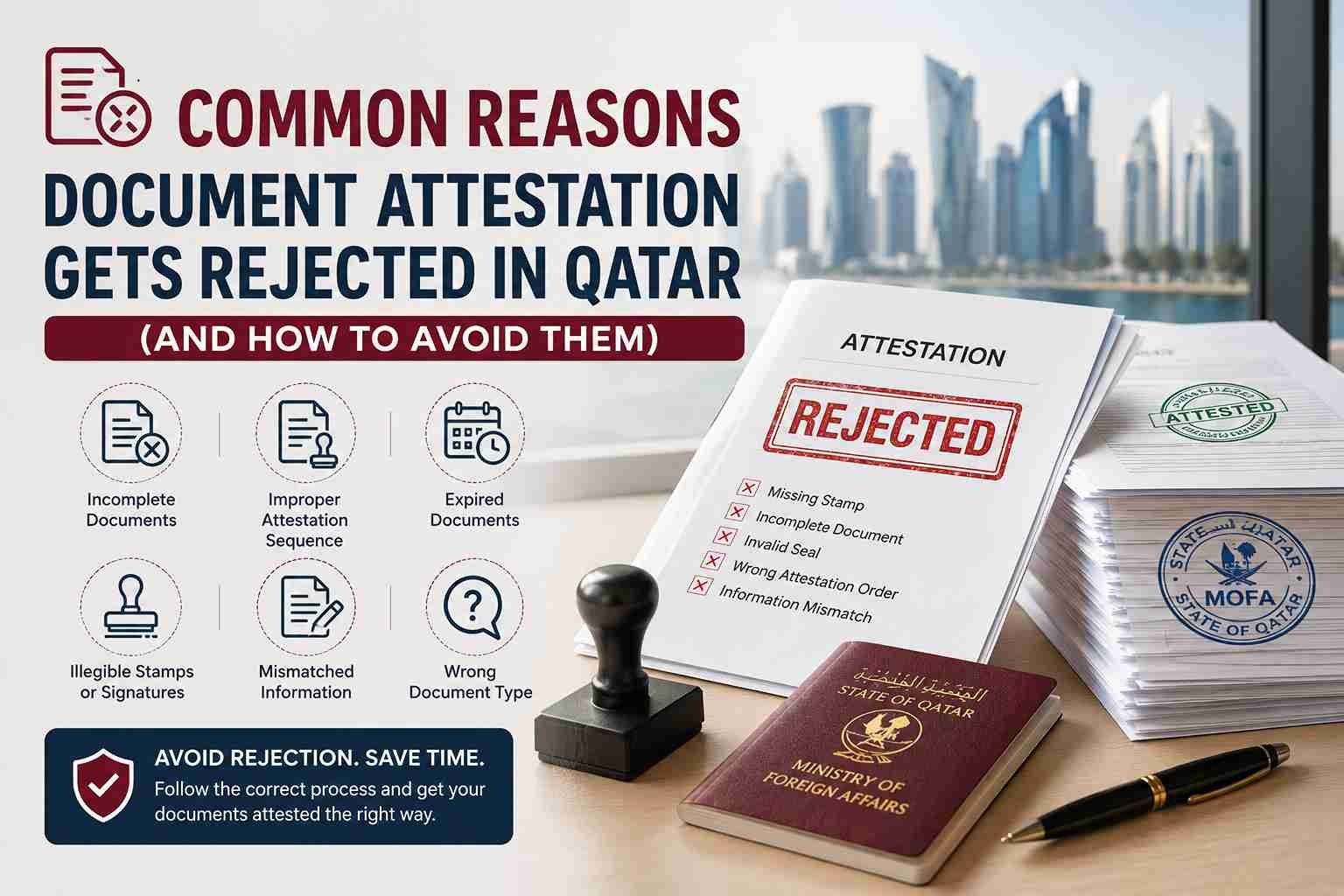
You’ve waited weeks for your document to go through the entire attestation chain, and then it happens, the document gets rejected at some stage, and you’re back to square one. If you’ve been through this, you know exactly how frustrating it feels. And if you haven’t started the process yet, this is exactly the kind of thing you want to avoid before it costs you time, money, and a whole lot of stress.
The good news is that most attestation rejections in Qatar happen for the same handful of reasons. Once you know what they are, they’re actually pretty easy to avoid. Let’s go through them one by one.
1. Submitting Photocopies Instead of Originals
This is probably the most common mistake people make. Attestation authorities almost always want the original document, not a photocopy, not a scanned printout, and definitely not a document that’s been laminated (more on that below).
People sometimes assume a clear, high-quality copy should be fine, especially if the original is old or fragile. But that’s not how attestation works. The whole point of the process is to verify the authenticity of the signatures and seals on the actual document, and that can’t be done properly with a copy.
How to avoid it: Always keep your original documents safe and use them for attestation. If you’re worried about damage or loss during the process, ask the service handling your attestation how they track and safeguard documents at each stage.
2. Laminated Documents
This one surprises a lot of people. Laminating a certificate to “protect” it seems like a smart move, but it can actually work against you. Some attestation authorities need to physically stamp or affix a sticker onto the document itself, and lamination makes that difficult or impossible without damaging the document further.
In some cases, authorities will outright reject a laminated certificate and ask you to get a duplicate issued from the original institution instead, which adds weeks to your timeline.
How to avoid it: If your degree, certificate, or marksheet is laminated, check with your attestation service before you start the process. It’s better to know upfront if you’ll need a fresh, non-laminated copy from your school or university.
3. Missing a Step in the Attestation Chain
Attestation isn’t a single stamp, it’s a chain. Depending on where your document is from, it usually needs to pass through notarization, a state or regional authority, your home country’s foreign affairs ministry, the Qatari embassy in that country, and finally Qatar’s own Ministry of Foreign Affairs (MOFA).
If even one of these steps is skipped or done out of order, the next authority in line will often reject the document outright. This happens more than you’d think, especially when people try to handle the process themselves without knowing the exact sequence required for their specific document and country.
How to avoid it: Confirm the complete attestation chain for your document type and country before you begin. Every country has a slightly different path, so what worked for your friend’s degree certificate from another country might not apply to yours.
4. Mismatched or Inconsistent Information
Small inconsistencies cause big problems in attestation. If your name is spelt differently on your passport versus your certificate, or if your date of birth doesn’t match across documents, this can trigger a rejection at any stage of the process.
Sometimes it’s something as simple as a middle name being present on one document and missing on another, or a document listing a maiden name that doesn’t match your current legal name.
How to avoid it: Before submitting anything, do a side-by-side check of your documents. Compare spellings, dates, and other identifying details across your passport, certificates, and any other supporting documents. If there’s a genuine mismatch, it’s better to get it corrected at the source before attestation begins, rather than discovering it midway through the chain.
5. Expired or Outdated Supporting Documents
Some documents, like police clearance certificates or medical reports, have a limited shelf life for attestation purposes. If too much time passes between when the document was issued and when it’s submitted for attestation, it may no longer be accepted.
This is easy to overlook, especially if there were delays at an earlier stage of your process that pushed your timeline out further than expected.
How to avoid it: Check whether your document type has a validity window for attestation purposes, and try to move through the process without long gaps between stages.
6. Incomplete or Incorrect Documentation Submitted Alongside the Main Certificate
Attestation isn’t just about the certificate itself. Depending on the authority, you might also need to submit a copy of your passport, your Qatar ID, proof of the requesting organisation’s requirements, or evidence of any prior attestation already completed on the document.
Missing even one of these supporting pieces can hold up or outright reject your submission.
How to avoid it: Before you submit anything, get a clear checklist of everything required for your specific document and situation. It’s worth asking directly rather than assuming the requirements are the same as someone else’s case.
7. Using an Apostille Instead of Full Attestation
This is a mix-up that happens a lot, and it’s worth clearing up clearly. Qatar is not part of the Hague Apostille Convention, which means an apostille stamp alone will not be accepted for documents headed to Qatar. If your document has been apostilled in its country of origin, it still needs to go through the full attestation process, including embassy legalisation, before it’s valid here.
How to avoid it: Don’t assume an apostille is enough just because it worked for another country. Always confirm the correct legalisation path for Qatar specifically.
8. Document Type Not Matching the Purpose It’s Being Used For
Sometimes the document itself is genuine and properly issued, but it doesn’t match what the requesting authority actually needs. For example, submitting a provisional certificate when the employer or ministry specifically asked for the final degree certificate, or submitting a general marriage certificate when a specific format is required for visa sponsorship.
How to avoid it: Double-check with the requesting authority in Qatar (employer, school, ministry, or embassy) exactly which document and format they expect before you start the attestation process.
Why These Mistakes Keep Happening
Honestly, most of these rejections don’t happen because people are careless. They happen because the attestation process has a lot of small, specific requirements that aren’t obvious unless you’ve been through it before, or unless someone tells you upfront. Every country of origin has its own quirks, every document type has its own rules, and the requesting authority in Qatar might have its own preferences on top of all that.
This is exactly why so many people choose to work with an experienced attestation service rather than figuring it out through trial and error. A good service will flag these issues before submission, not after a rejection has already cost you weeks.
If you want to avoid these pitfalls altogether, it’s worth getting your documents reviewed by professionals who handle this process daily. You can check out our full range of attestation services in Qatar to see how we manage everything from document review to final MOFA approval, so your documents get accepted the first time, not the third.
Final Thoughts
Document attestation rejections are frustrating, but almost all of them come down to a small set of avoidable mistakes: submitting the wrong format, missing a step in the chain, or overlooking a detail that seemed too small to matter. Taking a little extra time to double-check your documents before you start, or getting professional eyes on them, can save you weeks of back-and-forth later. A smooth attestation process means one less thing standing between you and your visa, your job, your child’s school admission, or whatever it is you’re working toward in Qatar.