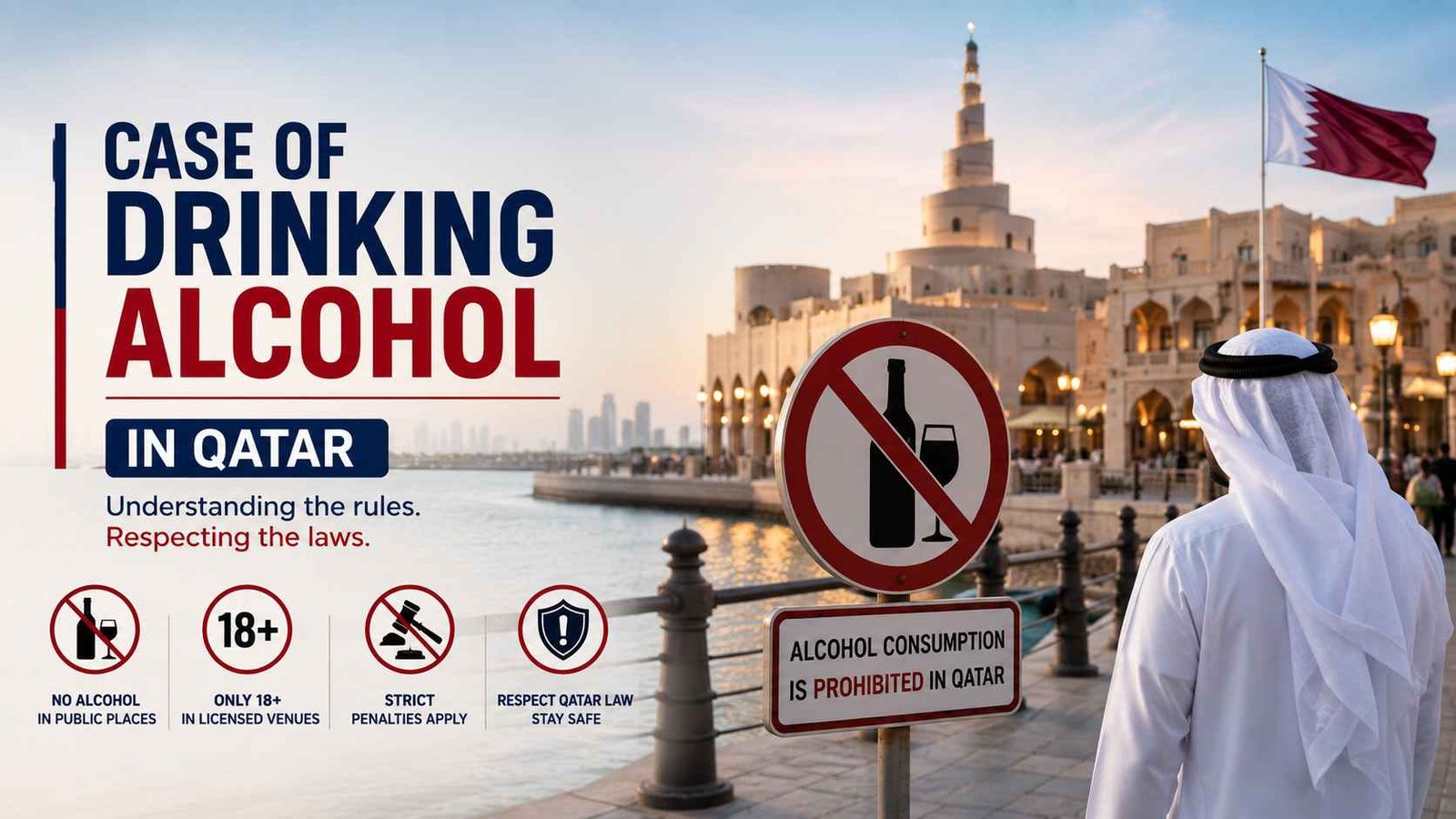
Qatar’s alcohol laws confuse a lot of residents and visitors — mostly because the country allows drinking in certain places while treating it as a serious criminal matter almost everywhere else. If you’re searching because you or someone you know is facing an actual case — an arrest, a police report, or a court summons — the vague tourist-blog advice floating around online won’t help you. This guide covers both sides: the legal rules for staying compliant, and what actually happens once a case has already started.
Is Alcohol Legal in Qatar?
Yes, but only within a narrow legal framework:
- Alcohol may only be consumed by non-Muslim adults aged 21 and over.
- It can legally be drunk in licensed hotel bars, restaurants, and clubs — almost always attached to international hotels.
- Non-Muslim residents can apply for a QDC (Qatar Distribution Company) permit to buy alcohol for private home consumption. QDC is the sole legal importer and retailer of alcohol in the country.
- Drinking in public, in a private car, or in any unlicensed venue is illegal, regardless of nationality or residency status.
- Importing alcohol into Qatar is banned, including small amounts carried in luggage or bought duty-free abroad — it will typically be confiscated at the airport.
How the QDC Liquor Permit Works
To legally buy alcohol for home use, non-Muslim expatriates need a QDC permit. The standard eligibility requirements are:
- A valid Qatar Residency Permit (QID), non-GCC nationality
- Minimum age of 21
- A basic monthly salary of at least QAR 3,000 (excluding allowances), confirmed by an employer letter
- No prior drug or alcohol-related convictions
Permit holders are given a monthly spending quota, alcohol must be consumed at the permit holder’s residence only, and it cannot legally be shared, resold, or given to anyone else — including other non-Muslim adults. QDC also closes entirely during Ramadan, though permit holders can usually buy extra quota in the weeks beforehand.
What Counts as an Alcohol Offence in Qatar
Based on Qatar’s Penal Code (Law No. 11 of 2004), the main offences are:
| Offence | Typical Penalty |
| Public intoxication / drinking in public (Article 270) | Fine of up to QAR 3,000 and/or imprisonment of up to 6 months |
| Driving under the influence of alcohol | 1 month to 3 years imprisonment, fines of QAR 10,000–50,000, and possible deportation |
| Importing, manufacturing, or illegally selling alcohol | Up to 3 years imprisonment and/or a fine of up to QAR 10,000 |
| Giving alcohol to a person under 16, or to a Muslim | Up to 3 years imprisonment and/or a fine of up to QAR 10,000 |
| Buying/possessing alcohol without a valid QDC permit | Confiscation, fines, and possible permit suspension for repeat offenders |
Because Qatar’s legal system draws on Islamic principles, case outcomes can vary based on individual circumstances. It’s always advisable to consult a licensed local lawyer for guidance specific to your situation.
Deportation is a realistic outcome even for first-time, non-violent offences, particularly for repeat public intoxication, driving under the influence, or importing alcohol.
What Happens If You’re Arrested: The Actual Process
This is the part most alcohol-law articles skip. Based on how these cases typically proceed:
- Detention — You’re usually held at a police station following the arrest, sometimes overnight or for a short period.
- Public Prosecutor review — Before any court referral, a public prosecutor reviews the circumstances. Minor incidents with no aggravating factors (disturbance, violence, driving) are sometimes resolved at this stage with a fine rather than proceeding to court.
- Possible court referral — More serious cases, repeat offences, or anything involving a disturbance, driving, or injury to another person can be referred to court.
- Outcome — A fine, a suspended or active prison sentence, and/or a deportation order, depending on severity and whether it’s a first offence.
- Travel restriction — It’s common for a travel ban to be placed on your Qatar ID until the case is formally closed, which can delay leaving the country even after release.
Throughout this process, your embassy can offer limited consular support (checking on your welfare, providing a list of local lawyers) but cannot intervene in Qatar’s legal process or get charges dropped — this is one of the most misunderstood points among expats and tourists.
Practical Steps If You’re Involved in a Case
- Don’t sign any statement in Arabic you don’t fully understand. Request a certified translation or interpreter before signing anything with the police or prosecutor.
- Contact your embassy as soon as possible for a list of local lawyers and to notify next of kin if needed.
- Get a local lawyer involved early, especially if the case is being referred to court rather than resolved with an on-the-spot fine.
- If you need someone back home to act on your behalf — managing your affairs, accessing accounts, or handling paperwork while your case is ongoing — you’ll likely need a Power of Attorney, properly notarised and translated so it’s accepted by Qatari authorities.
- Any foreign legal documents used in your case (identity documents, prior records, employer letters) generally need certified Arabic translation and, in many instances, formal attestation before Qatari authorities will accept them.
How Sheen Services Can Help
Legal cases move fast in Qatar, and paperwork delays are one of the most common reasons people struggle to respond in time. Sheen Services WLL has supported individuals and families in Doha since 2009 with exactly this kind of documentation:
- If you need a Power of Attorney so a family member or lawyer can act on your behalf while you’re detained or your case is ongoing, our notary services prepare and process this through an MOJ-licensed advocate.
- If statements, ID documents, or employer letters need to be translated into Arabic for the prosecutor or court, our certified translation services cover legal and personal documents in over 200 languages.
- If your case involves visa status, labour approvals, or Qatar ID issues that need liaising with government departments, our PRO services team can help move things along.
Talk to our team if you need documentation handled quickly and correctly — we understand these situations are stressful and time-sensitive.
FAQs
Is it legal to drink alcohol in Qatar? Yes, but only for non-Muslim adults aged 21+, and only in licensed hotel bars/restaurants or at home with a valid QDC permit. Drinking in public or in an unlicensed venue is illegal for everyone.
What is the penalty for public intoxication in Qatar? Under Article 270 of the Penal Code, it can carry a fine of up to QAR 3,000 and/or up to 6 months in prison, though minor first-time incidents are sometimes resolved with a fine at the prosecutor stage.
Can tourists drink alcohol in Qatar? Yes — tourists can drink in licensed hotel bars and restaurants without needing a personal QDC permit, but the same public drinking laws apply.
Can I be deported for an alcohol offence in Qatar? Yes, deportation is a realistic outcome, especially for repeat offences, driving under the influence, or importing alcohol, even without other aggravating factors.
Can my embassy get my case dropped? No. Embassies can offer welfare checks and a list of local lawyers, but they cannot intervene in or influence Qatar’s legal process.