
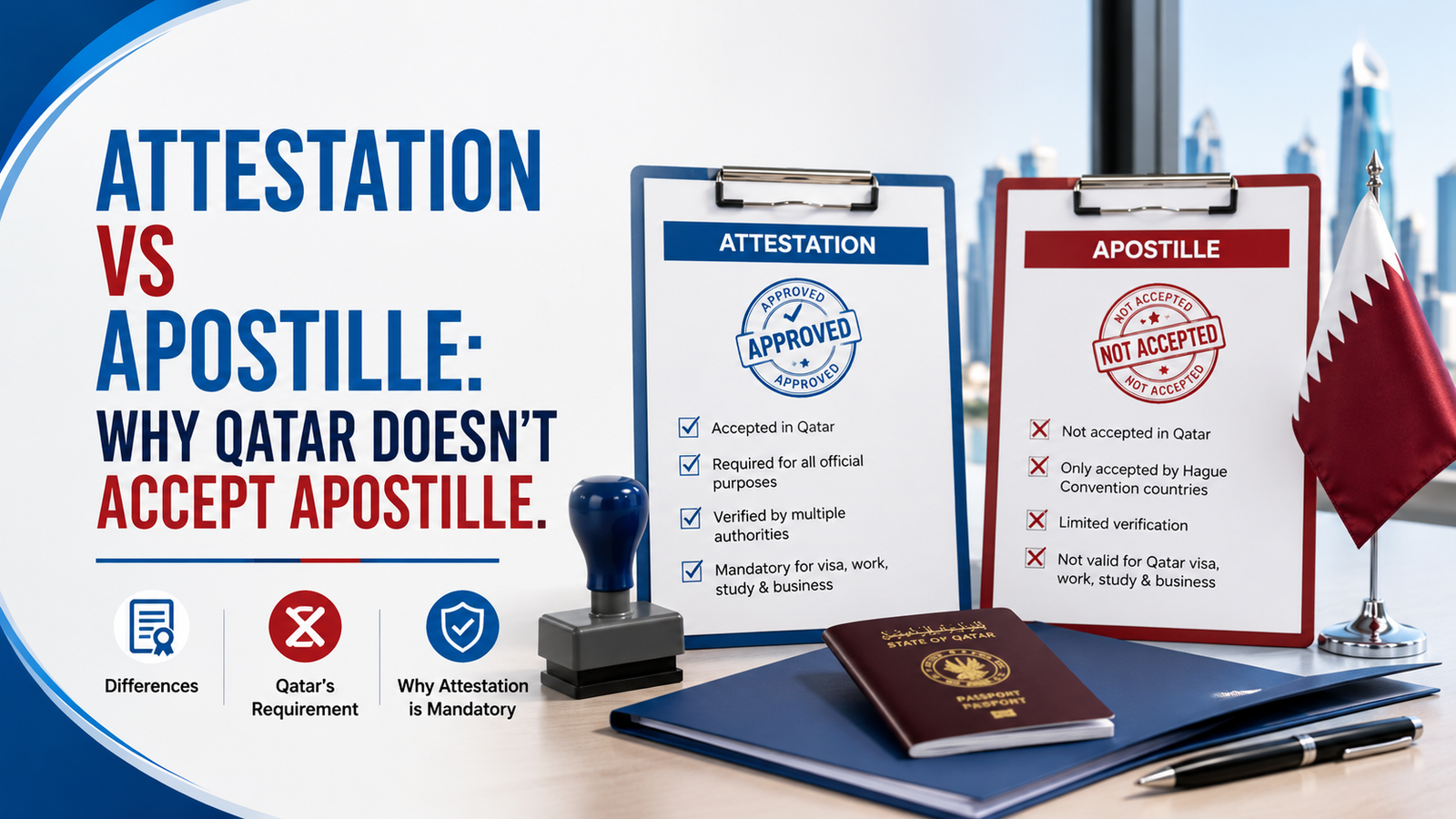
If you’ve dealt with international paperwork before, especially for a country in Europe or the US, you might already know about the apostille — that neat single stamp that’s supposed to make a document valid across dozens of countries in one step. So naturally, when people start their Qatar paperwork, a common question comes up: “Can I just get an apostille instead of going through this whole attestation chain?”
The short answer is no. Qatar does not accept apostilled documents, full stop. But the “why” behind that is worth understanding, because it explains a lot about how the rest of your document process is going to work.
What Is an Apostille, Exactly?
An apostille is a certification issued under the 1961 Hague Convention, an international agreement that lets countries recognise each other’s official documents without needing a full chain of embassy-level verification. If both the country that issued the document and the country receiving it are members of this convention, a single apostille stamp from a designated authority is enough. One stamp, done.
It’s a convenient shortcut, and it works well between member countries. The catch is right there in that sentence: it only works between countries that are part of the same agreement.
Why It Doesn’t Apply to Qatar
Qatar is not a signatory to the Hague Apostille Convention. That’s really the whole answer. Since Qatar hasn’t joined the agreement, it has no obligation, and no mechanism, to recognise an apostille stamp from another country. As far as Qatari authorities are concerned, an apostille on your document simply doesn’t mean anything official to them.
This isn’t unique to Qatar, either — several Gulf countries follow the same approach and rely on their own full legalisation process instead of the apostille system.
So even if your home country is part of the Hague Convention and your document already carries a valid apostille, Qatar will still ask you to go through the complete attestation process from scratch: verification at the source, attestation by your home country’s foreign ministry, attestation by the Qatar Embassy, and finally, MOFA attestation once you’re in Qatar. The apostille doesn’t shortcut any of that.
Attestation vs Apostille: The Core Difference
| Apostille | Attestation | |
| Based on | Hague Convention (1961) | Bilateral/direct government-to-government verification |
| Number of stamps | Usually one | Multiple, through a defined chain |
| Recognised by | Other Hague member countries only | Whichever specific country the attestation was done for |
| Accepted in Qatar | No | Yes (this is the required process) |
| Typical steps | Single designated authority | Source verification → home ministry → embassy → MOFA |
The simplest way to think about it: an apostille says, “This is valid everywhere within our club.” The attestation says, “This specific document has been individually verified for use in this specific country.” Qatar only works with the second kind.
What This Means for You, Practically
If you’re coming from a Hague Convention country—the UK, the US, Canada, Australia, and many others—don’t assume the apostille you already have (or plan to get) will save you time in Qatar. It won’t be accepted, and starting the attestation chain assuming it will just leads to delays when it’s rejected at the MOFA stage.
Instead, plan for the full route from the beginning:
- Verification of the original document at the source (university, registrar, notary, or chamber of commerce)
- Attestation from your home country’s Ministry of Foreign Affairs (or equivalent)
- Attestation from the Qatar Embassy or Consulate in your home country
- Final MOFA attestation once the document is submitted in Qatar
If you want the exact breakdown of these steps, we’ve covered it in detail in our guide to MOFA attestation in Qatar, including timelines and common rejection reasons.
A Common Mix-Up: “But My Document Already Has an Apostille”
This comes up a lot, and it’s worth addressing directly. Having an apostille doesn’t invalidate your document — the document itself is still genuine — but the apostille stamp simply isn’t a credential Qatar recognises. You’ll still need to go back and complete the attestation chain in parallel, or in some cases, alongside the apostille, depending on your document type and home country’s process. It’s rarely a case of “redoing” work from zero, but it does mean an extra layer that a Hague Convention country like Spain or Germany wouldn’t otherwise require.
If you’re not sure whether your specific document needs additional attestation on top of an apostille you already hold, it’s worth getting it checked properly rather than guessing and risking a rejection later at MOFA. Our attestation services team can review what you already have and tell you exactly what’s still missing.
Does Any Part of the Apostille Process Help At All?
In a few cases, yes — the underlying verification step that led to your apostille (like a notarisation or registrar confirmation) can sometimes double as the “source verification” step needed for attestation. This depends on your home country’s specific rules, so it’s not something to assume without checking. If your document was notarised as part of getting the apostille, that notarisation may still be useful; the apostille stamp itself just won’t be.
Final Thoughts
The apostille exists to make life easier between countries that have agreed to trust each other’s stamps. Qatar simply isn’t part of that agreement, so it relies on its own full attestation process instead – the home country ministry, the Qatar Embassy, and finally MOFA. It’s a longer road than an apostille, but it’s a predictable one once you know the sequence.
If you’re not sure where your documents currently stand or whether an apostille you already have is doing you any good here, get in touch for a free consultation and we’ll tell you exactly what’s needed to get your documents accepted in Qatar.