
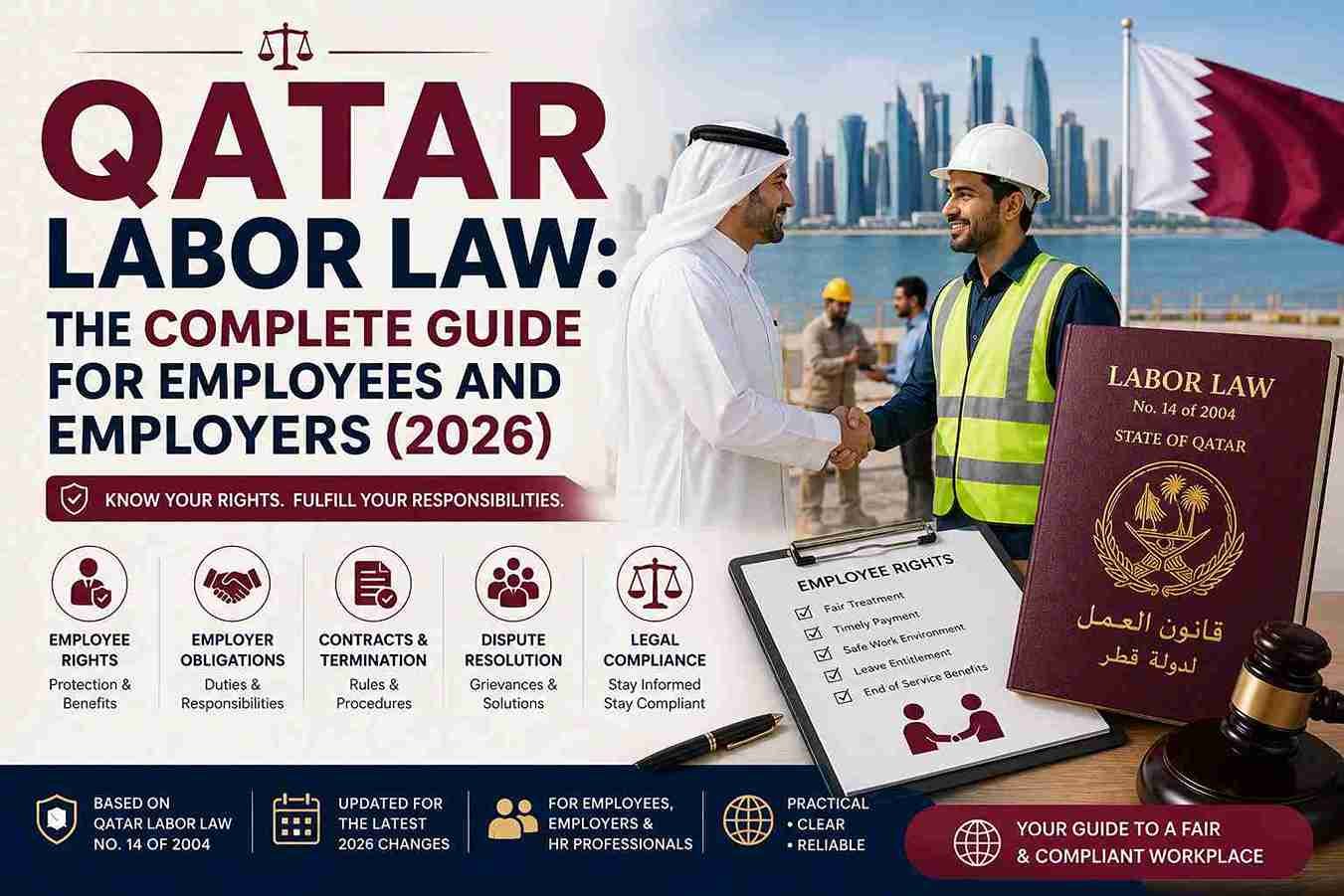
Qatar’s labour law touches almost every part of working life here — what happens if you’re hurt on the job, how much authority your employer really has over you, what fines you’re looking at if your Iqama lapses, and what you need to sort out before you leave the country. Most people only look into one of these at a time, usually when something’s already gone wrong.
This guide puts everything in one place, so whether you’re an employee trying to understand your rights or an employer trying to stay compliant, you don’t have to hunt across a dozen different pages to get the full picture.
1. What Happens If You’re Injured at Work
If you’re hurt while doing your job in Qatar, the law is fairly clear about what should happen next — but a lot of workers only learn this after the fact, when they’re already dealing with a hospital visit and a confused HR department.
Employers are required to report workplace injuries and provide medical treatment, and depending on the severity, the employee may be entitled to compensation covering treatment costs and lost income during recovery. Serious or permanent injuries can carry higher compensation, and in some cases, injuries resulting from unsafe working conditions can open the door to a broader liability claim against the employer (more on that below).
Practically speaking, if you’re injured at work:
- Report the incident to your employer immediately, in writing if possible
- Get medical treatment and keep every document — reports, receipts, prescriptions
- Ask for a copy of the incident report your employer files
- If your employer isn’t cooperating, the Ministry of Labour can be approached directly
Delaying the paperwork is one of the most common reasons workers struggle to get fair compensation later, so documenting everything early matters more than it seems like it should at the time.
2. How Much Disciplinary Power Does Your Employer Actually Have?
Employers in Qatar do have the legal right to discipline employees for things like repeated lateness, misconduct, or breach of company policy. But that authority isn’t unlimited, and it has to follow a proper process. It’s not a free pass to dock pay, suspend, or terminate someone without cause or documentation.
Generally, disciplinary steps are expected to be proportionate and documented – a verbal warning before a written one, a written warning before suspension, and so on, unless the conduct is serious enough to justify immediate action. Employees are usually entitled to know exactly what they’re being disciplined for and, in many cases, to respond before a final decision is made.
Where this gets murky is when employers overstep — deducting wages without legal grounds, terminating without following notice requirements, or applying penalties that go beyond what’s proportionate to the issue. If that happens, it’s worth getting the details in writing and, if necessary, raising it with the Ministry of Labour before agreeing to anything you’re not sure about.
3. Before You Report Your Employer to the Labor Department
Filing a complaint against your employer is a serious step, and doing it right the first time makes a real difference in how quickly (and fairly) it gets resolved. A few things worth sorting out before you file:
Before submitting a formal complaint, it is important to understand your rights, prepare the necessary evidence, and review the available options. For a more detailed explanation, read our 6 things to consider before reporting your employer to the Labour Department in Qatar.
Gather your documentation first. Contracts, payslips, messages, warning letters — anything relevant to your complaint. Complaints backed by paperwork move faster than ones based on verbal accounts alone.
Know exactly what you’re complaining about. Unpaid wages, unfair termination, and workplace safety are handled differently, so being specific from the start saves time.
Check your notice and contract terms. If your complaint involves resignation or termination, knowing what your contract says about notice periods helps you understand where you actually stand.
If you are considering resigning or your employment is being terminated before your contract ends, it is important to understand the applicable notice requirements and employment rights. Read our guide to resignation or termination after one year in Qatar before completing your contract for more information.
Consider talking to your employer first, if it’s safe and reasonable to do so. Some disputes get resolved without ever needing a formal complaint — though this isn’t always possible, and you’re never obligated to try if the situation feels unsafe or hostile.
Understand the process timeline. Labour disputes in Qatar typically go through the Ministry of Labour’s dispute resolution committee before escalating further, and that process takes time — so go in with realistic expectations.
Employee concerns may also involve an employer retaining a worker’s passport or refusing to return it. Passport retention is a separate issue from salary disputes and other employment complaints. For more information, read our guide to passport retention in Qatar, employer rules and employee rights.
4. Wrapping Things Up Before You Leave Qatar
Whether you’re leaving for good or just heading home for a while, there’s a checklist that’s easy to overlook in the rush of last-minute packing:
- Settle your Iqama status — make sure it’s properly cancelled or transferred, depending on your situation, so you’re not accumulating fines while you’re gone
- Clear final dues — under Qatar labor law, your final settlement (salary, gratuity, unused leave) is generally due shortly after your last working day
- Get your experience/service certificate — employers are required to provide this on request, and you’ll likely need it for future job applications
- Sort out your bank account and utilities — closing or transferring these before you leave avoids ongoing charges you won’t be around to catch
- Check your exit permit requirements, if applicable to your sponsorship category
- Keep copies of everything — your contract, ID, final settlement, and any correspondence with your employer — in case a dispute comes up after you’ve left
- Changing employers instead of leaving Qatar? If you are moving to another employer while remaining in Qatar, the process is different from permanently leaving the country. Read our guide to changing employers in Qatar for information about the employer-change process, applicable notice requirements, and supporting documents.
- Clear final dues — under Qatar labour law, your final settlement (salary, gratuity, unused leave) is generally due shortly after your last working day. For broader information about compensation, read our guide to salary and employment benefits in Doha, Qatar.
- For more information, read our guide to calculating end-of-service gratuity in Qatar.
If you’re planning to return to Qatar in the future, keeping your paperwork clean on the way out saves a lot of complications on the way back in.
5. Can You Hold Your Employer Liable for Damages?
Yes — under certain conditions. If your employer’s negligence, unsafe practices, or breach of contractual obligations directly caused you financial or physical harm, Qatar law does allow for a damages claim. This isn’t limited to workplace injuries; it can also cover situations like unlawful termination, failure to provide agreed benefits, or breach of contract terms that caused you measurable loss.
That said, proving liability requires more than just showing something went wrong — you generally need to demonstrate a direct link between the employer’s action (or failure to act) and the harm you experienced. This is where documentation, again, becomes the deciding factor in how strong your case is.
6. Employer’s Liability for an Employee’s Actions
The relationship runs both ways — employers can also be held responsible for actions their employees take while performing their job duties. If an employee causes harm to a third party while acting within the scope of their employment (say, a delivery driver causing an accident during work hours), the employer can be held liable, not just the employee personally.
This matters most in industries where employees regularly interact with the public, operate equipment, or represent the company externally. Employers are generally expected to have reasonable oversight, training, and safety measures in place — and a failure to do so can strengthen a claim against them if something goes wrong.
7. Fines and Penalties for Not Renewing Your Iqama on Time
Letting your Iqama (residence permit) lapse isn’t just an administrative slip — it comes with real, accumulating costs.
Generally, there’s a grace period of around 90 days after expiry before fines start kicking in. After that, a daily fine (commonly cited around QAR 10/day) begins accumulating, and it keeps building until you renew or leave the country — with some sources indicating a cap in the thousands of riyals. Beyond the financial penalty, an expired Iqama can also block access to banking, healthcare, mobile services, and other essentials tied to your ID, and continued non-renewal can lead to more serious consequences, including travel restrictions.
Rates and grace periods do get updated from time to time, so it’s worth confirming the current fine structure directly through Metrash2 or the MOI portal before assuming any specific number applies to your case. If you’re an employer managing renewals for staff, staying ahead of these deadlines is a lot cheaper than catching up on fines later.
Sick Leave Entitlements Under Qatar Labour Law
Employees in Qatar may be entitled to sick leave under the applicable labour law, subject to eligibility requirements and supporting medical documentation. The rules governing sick leave, payment and supporting evidence depend on the employee’s circumstances and the applicable legal provisions.
For a detailed explanation of sick leave eligibility, payment rules and medical certificate requirements, read our guide to sick leave under Qatar Labour Law.
8. Maternity Leave and Women’s Employment Rights in Qatar
Qatar’s labor law includes specific protections for women, and maternity leave is one of the most important. Under the core labor law, female employees with sufficient service are entitled to paid maternity leave, generally split between time taken before and after childbirth, along with a minimum period that must be taken after delivery. New mothers are also entitled to paid nursing breaks for a period after returning to work.
Employers are prohibited from dismissing a female employee because of pregnancy, maternity leave, or related illness, and recent updates have expanded some of these protections further for specific cases, such as multiple births or a child with a disability.
If you’re an employer, it’s worth reviewing your current maternity policy against the latest labor law updates rather than relying on what was standard a few years ago — this is an area that has genuinely changed, and getting it wrong can lead to real compliance exposure.
Staying Compliant Without the Guesswork
Between disputes, disciplinary questions, Iqama renewals, and maternity policy, Qatar labour law compliance isn’t a one-time task—it’s ongoing, and it’s easy for one overlooked detail to turn into a real problem for either side. If you need help with the PRO and government-facing side of any of this — Iqama processing, labour approvals, or compliance documentation — Sheen Services’ PRO services team handles this daily.
Talk to our team → Or reach us directly: (+974) 5575 2696