
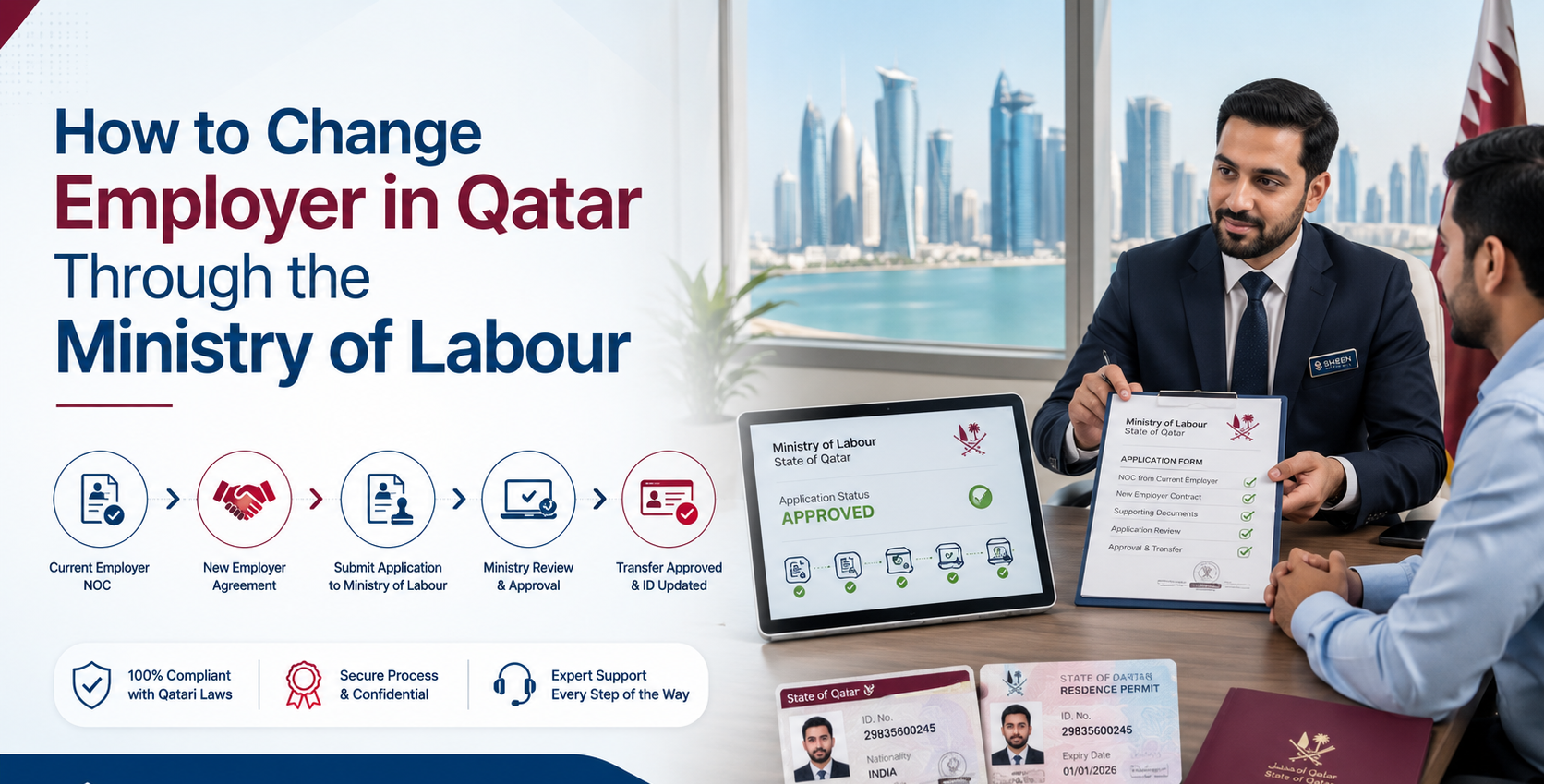
Employees who want to change employer in Qatar can use the Ministry of Labour’s electronic employer-change service, provided they meet the applicable employment, notice-period, residency, and documentation requirements.
Qatar’s labour reforms removed the general legal requirement for workers to obtain a No Objection Certificate from their current employer before changing jobs. However, this does not mean that an employer transfer is automatic. Workers must still follow the official process, provide the correct notice, submit accurate information, and receive approval from the relevant authorities.
The Ministry of Labour describes its employer-change notification service as a process for reviewing and deciding requests to transfer a worker residing in Qatar from one employer to another.
This guide explains who may apply, how the online process generally works, what documents may be required, how notice periods apply, and what can delay an application.
Employees and companies needing help with employment-related government procedures can use Sheen Services’ PRO services in Qatar.
Important: Labour, immigration, contract, and electronic-service procedures can change. Applicants should check the current Ministry of Labour and Ministry of Interior requirements before submitting an application.
What Is Employer Change in Qatar?
Employer change is the official process of transferring an expatriate worker’s employment record from the current employer to a new employer within Qatar.
It may involve updates to:
- The worker’s employment relationship
- The Ministry of Labour record
- The employment contract
- Sponsor or employer information
- Residence and immigration records
- The worker’s profession, where separately required
- Company labour and immigration files
Employer change is different from simply resigning or accepting a new job offer. A worker should not normally begin working for the new company until the required transfer and employment procedures have been completed.
The Ministry of Labour currently provides an electronic service through which employer-change requests can be submitted and reviewed.
Can Employees Change Employers in Qatar?
Workers in Qatar can generally change employers without obtaining an NOC, including during the term of their employment contract, subject to the applicable legal procedure and notice requirements.
The process may still depend on:
- The worker’s current employment status
- Whether the residence permit remains valid
- The employment contract
- The applicable notice period
- Whether the worker is in probation
- The new employer’s eligibility
- Correct submission of the application
- Ministry of Labour approval
- Completion of related Ministry of Interior procedures
Workers should not assume that the current employer’s permission is legally required in every standard case. At the same time, they should not ignore contractual handover duties, notice requirements, or official procedures.
Labour Mobility Reforms
Qatar introduced major labour-mobility reforms in 2020. These reforms removed the previous legal requirement for migrant workers to obtain their employer’s permission through an NOC before changing jobs.
The reforms were intended to allow workers to move between employers through a regulated notification and transfer process.
The Ministry of Labour and Ministry of Interior use connected systems to review employment-change information and related residency records. International Labour Organization reporting has also noted that electronic employer-change processes are intended to reduce unnecessary interference and improve labour mobility.
Is an NOC Required?
An NOC is not generally required by law for workers changing employers through the official process.
However, employees must still comply with conditions such as:
- Written notice
- Contractual obligations
- Ministry submission
- Accurate worker and employer records
- Probation rules, where applicable
- Residency and immigration requirements
- Approval of the new employment contract
An employer may agree to waive or reduce the notice period, but this is different from requiring an NOC as permission to change jobs.
Who Can Apply for an Employer Change?
The Ministry’s service applies to workers residing in Qatar who seek to move from one employer to another, subject to the service’s eligibility rules and review.
Depending on the current electronic workflow, the process may involve:
- The worker
- The new employer
- The current employer
- An authorised company representative
- A company PRO
- The Ministry of Labour
- The Ministry of Interior
The new employer should be eligible to hire the worker and should have valid company, labour, and immigration records.
The worker should normally have:
- A valid Qatar ID or residence record
- Correct passport information
- An active or identifiable employment record
- A new employment opportunity
- Compliance with the applicable notice requirement
- No unresolved issue preventing the transfer
Separate processes may apply to government employees, domestic workers, family-sponsored residents joining the labour market, or workers moving between specially regulated sectors.
Eligibility Requirements
Although every case is reviewed individually, common eligibility considerations may include:
- The worker is legally residing in Qatar.
- The worker’s identity and employment information are correct.
- The new employer is properly registered and eligible to hire.
- The employment contract and job details are valid.
- The correct notice period has been entered.
- The worker is not subject to an unresolved immigration restriction.
- Required company approvals or worker quotas are available.
- The application has been submitted through the correct service.
- Supporting records are complete and consistent.
The Ministry does not approve an application simply because the worker has clicked “submit.” It reviews the information and may approve, reject, return, or request changes to the application.
Documents Required to Change Employer in Qatar
The exact document list depends on the worker’s status, current employer, new employer, profession, and Ministry requirements.
Worker documents:
- Qatar ID copy
- Passport copy
- Current employment information
- Mobile number linked to official records
- Existing employment contract
- New job offer or contract
- Resignation or notice information
- Educational or professional documents, where relevant
- Additional explanation or supporting evidence, where requested
New-employer documents:
- Commercial registration
- Trade licence
- Establishment card
- Labour establishment details
- Authorised-signatory information
- Proposed employment contract
- Job title and salary information
- Company contact details
- Worker quota or approval information, where applicable
Additional supporting records, some cases may require:
- Evidence of notice submission
- Agreement to waive or amend the notice period
- Proof of contract termination
- Labour complaint information
- Professional licence
- Academic certificates
- Certified translation
- Attested qualifications
Documents issued in another language may require certified translation services in Qatar where Arabic or another accepted format is requested.
Educational or professional documents may also require certificate attestation services in Qatar for related employment, profession, or licensing procedures. Attestation is not automatically required for every employer-change application.
Step-by-Step Online Employer Change Process
The following is a general guide. The exact portal fields and sequence may be updated by the Ministry.
Step 1: Confirm the New Employment Offer Before beginning the transfer, the worker and new employer should agree on job title, salary, allowances, workplace, contract period, probation terms, start date, and notice-period arrangements. The worker should review the offer carefully before submitting an employer-change request.
Step 2: Review the Current Employment Contract Check length of service, contract type, notice period, probation status, handover duties, outstanding salary or benefits, and company property that must be returned. The employment contract should be considered together with Qatar’s current labour rules.
Step 3: Submit the Employer-Change Application The application is submitted through the Ministry of Labour’s current electronic employer-change service. The applicant may need to enter the worker’s Qatar ID, mobile number, current-employer details, new-employer details, proposed profession, contract information, notice-period information, effective transfer date, and supporting notes. The Ministry’s employer-change user guide includes options to enter or amend the legal notice period and, where applicable, select a notice-period waiver.
Step 4: Record the Application Reference After submission, retain the application or EC reference number. The worker and new employer should save the application number, submission date, confirmation message, screenshots or downloaded records, and copies of uploaded documents. The ILO’s worker guidance specifically advises workers to retain the employer-change reference number.
Step 5: Ministry of Labour Review The Ministry reviews the application and may check worker eligibility, new-employer eligibility, employment-contract details, notice period, company compliance, labour and residency records, accuracy of the submitted information, and whether further documents are required. The application may be under review, approved, returned for correction, rejected, cancelled, or awaiting further action.
Step 6: Employer Notification The current employer may receive notification of the worker’s intention to change employment. Notification does not necessarily mean the current employer has the right to block the transfer simply by refusing permission. However, the employer may raise legitimate issues regarding notice, contract, worker records, or legal obligations through the applicable process. The worker should continue to follow lawful workplace duties during the notice period unless another arrangement is officially accepted.
Step 7: Complete the Notice Period After the probation period, the standard notice period generally depends on length of service: two years of service or less requires at least one month’s written notice, and more than two years of service requires at least two months’ written notice. The notice period may be reduced or waived where the parties agree and the system permits the adjustment. Workers should not stop attending work without confirming the legal and contractual consequences.
Step 8: Approve and Authenticate the New Contract The new employer may need to prepare and authenticate the employment contract through the Ministry’s electronic contract system. The Ministry provides an integrated digital employment-contract authentication service. The worker should review their name, passport and QID details, job title, salary, allowances, contract duration, probation period, working location, and start date. Errors should be corrected before the contract is finalised.
Step 9: Complete Final Approval Once the Ministry approves the change and the notice or waiver requirements are completed, the new employer may continue with the remaining labour and immigration procedures. Approval may still depend on valid residence status, new-employer compliance, contract authentication, job and profession approval, labour-system updates, and Ministry of Interior processing.
Step 10: Update Residency and Employer Records After the labour transfer, related residency records should be checked. This may include updating employer or sponsor information, employment contract, worker’s labour record, residence-permit details, profession if separately approved, and company immigration records. Do not assume that every record updates at exactly the same moment.
How to Track Employer Change Status
The Ministry of Interior provides an online employer-change application enquiry service. The enquiry requires the application number and the worker’s or authorised person’s identification details.
Applicants should keep the original reference number because it may be required for status checks.
Possible statuses may include: Submitted, Under review, Pending, Returned, Approved, Rejected, Completed, or Cancelled.
If the application remains pending, check whether:
- Additional documents are required
- Notice-period action is incomplete
- The new employer must complete a step
- Contract information needs correction
- Worker or company records do not match
Notice Period Rules for Employer Change in Qatar
Notice is one of the most important parts of the employer-change process.
After probation, workers generally provide:
- One month’s notice if they have worked for the employer for two years or less
- Two months’ notice if they have worked for the employer for more than two years
The Ministry’s electronic system may allow the legal notice period to be entered, amended within the permitted maximum, or waived where appropriate.
Employees should submit notice in a way that creates a record, such as:
- Official electronic notification
- Signed resignation letter
- HR acknowledgement
- Ministry application reference
Notice rules should not be confused with the old NOC requirement.
Can the Notice Period Be Waived?
The notice period may be waived or reduced where the current employer and worker agree and the Ministry’s system accepts the arrangement.
A waiver may be useful when:
- The current employer agrees to an early release
- The worker has completed all handover duties
- The new employer needs an earlier start
- The parties have resolved all settlement matters
The employer-change user guide includes a notice-period waiver option. Workers should keep written evidence of any agreement.
Changing Employers During Probation
Changing employers during probation can involve different rules.
ILO guidance on Qatar’s labour-mobility framework states that a worker changing employers during probation generally gives at least one month’s written notice. In such cases, the new employer may be required to compensate the current employer for certain recruitment and ticket costs, subject to the legal limit.
The worker should check probation length, date probation began, contract terms, required written notice, new-employer obligations, and Ministry instructions.
Probation should not exceed the maximum permitted by the applicable law and contract.
Need Help Understanding the Employer-Change Process?
Sheen Services can review the available employment records and help identify the documentation or government steps that may be relevant before an application is submitted.
Suggested button: Check My Employer Change Eligibility
Our support does not guarantee Ministry approval.
Common Reasons for Delay or Rejection
- New employer is not eligible – The new company may have expired registrations, compliance issues, insufficient labour approval, or another restriction affecting the application.
- Incorrect worker information – A difference in the worker’s name, QID, passport number, nationality, or employment details can cause a problem.
- Notice period entered incorrectly – The requested transfer date may not match the applicable notice requirement.
- Application data is incomplete – Missing employer details, contract information, or supporting documents can delay review.
- Employment contract issues – The proposed salary, job title, profession, or contract terms may require correction.
- Residence record problems – An expired, cancelled, or inconsistent residence record may affect the transfer.
- Profession or qualification mismatch – The proposed role may require qualifications, licensing, profession modification, translation, or attestation.
- Duplicate or previous application – An unresolved earlier request may prevent a new application from progressing.
- Worker cancels the application – ILO reporting notes that employer-change applications may also be rejected or closed because of submission errors, new-employer non-compliance, or worker cancellation.
Common Mistakes to Avoid
Avoid these common errors:
- Leaving the job without submitting official notice
- Assuming an NOC is still mandatory
- Assuming no procedure is needed because the NOC requirement was removed
- Entering the wrong notice period
- Starting work for the new company too early
- Submitting an expired passport or QID
- Using a job title unsupported by the worker’s qualifications
- Failing to save the application reference
- Ignoring Ministry messages
- Signing a contract without checking salary and benefits
- Failing to collect final-settlement records from the previous employer
Workers should keep copies of all important employment and transfer documents.
What Should You Collect From the Previous Employer?
Before completing the move, the worker should request and retain:
- Final salary statement
- End-of-service calculation, where applicable
- Unused-leave settlement
- Experience certificate
- Service certificate
- Resignation acknowledgement
- Handover confirmation
- Copies of previous contracts
- Salary records
- Any agreed notice waiver
- Confirmation that company property was returned
Employer change does not automatically settle all financial or contractual matters with the previous employer.
How Sheen Services Can Help
Changing employers can involve Ministry of Labour applications, employment contracts, document corrections, translation, qualification records, residence procedures, and company follow-up.
Sheen Services WLL can assist with:
- Preliminary document review
- Employment-document preparation
- Employer-change application support
- Notice-period documentation
- Employment-contract coordination
- Certified translation
- Certificate-attestation coordination where relevant
- Profession-change documentation
- Labour and immigration follow-up
- Related PRO services
Sheen Services provides administrative and documentation assistance. Final approval remains with the Ministry of Labour, Ministry of Interior, and other competent authorities.
Frequently Asked Questions
Can I change my employer in Qatar without an NOC? Yes. Qatar’s labour reforms removed the general legal requirement for workers to obtain an NOC before changing employers. Workers must still follow the official process, submit notice, and meet Ministry requirements.
Who can apply for an employer change? A worker residing in Qatar may apply to move from one employer to another, subject to the Ministry’s eligibility and approval process. The new employer and authorised company representatives may also need to complete parts of the process.
How do I apply to change employer online? The application is submitted through the Ministry of Labour’s employer-change service. The applicant enters worker, current-employer, new-employer, contract, and notice-period information and retains the application reference.
What documents are required? Common records include the worker’s QID, passport, current employment information, new job offer or contract, notice details, and new-employer documents. Additional records may be requested depending on the case.
Can I change employers during probation? A worker may be able to change employers during probation. Different notice and compensation rules may apply, including one month’s written notice and possible compensation by the new employer within the legal limit.
Can the notice period be waived? The notice period may be reduced or waived by agreement, subject to the applicable Ministry process. The electronic user guide includes a notice-period waiver function.
How long does employer-change approval take? There is no single guaranteed timeline. Processing depends on application accuracy, notice requirements, employer compliance, contract approval, Ministry review, and whether additional documents are requested.
Conclusion
Employees who want to change employer in Qatar no longer generally need an NOC, but they must still follow the official Ministry process.
A proper employer transfer involves checking eligibility, submitting accurate information, complying with the required notice period, obtaining Ministry approval, authenticating the new employment contract, and updating related labour and residence records.
Workers should keep their application reference, monitor the status, respond to document requests, and avoid starting with the new employer before the required procedures are completed.
Planning to Change Your Employer in Qatar?
Sheen Services can assist with employment-document preparation, certified translation, employer-change procedures, contract coordination, and related PRO support.
Contact Sheen Services with your Qatar ID details, current employment status, length of service, notice-period information, and new job-offer details for an initial review.
Suggested CTA buttons: Contact Our PRO Team | Request Employer Change Assistance
Important Disclaimer This article provides general information and does not constitute legal or employment advice. Labour rules, notice requirements, electronic procedures, contract conditions, and immigration processes may change. Final approval remains with the relevant Qatar authorities